

PerformanceObserver: observe() method
Specifies types of performance events to observe and starts observing. The callback function set when creating the PerformanceObserver will be invoked when a matching
PerformanceEntry is received.
Syntax
Parameters
entryIdentifiers
A string list of identifiers for the PerformanceEntry to be observed.
You can use entryType or entryType.name as identifiers. For example, you can use "metric" to listen to performance events for the entire metric type,
including MetricFcpEntry and MetricActualFmpEntry. Alternatively, you can use "metric.fcp" to listen only to the MetricFcpEntry performance event.
Refer to PerformanceEntry.entryType and PerformanceEntry.name for available types
and names. Unrecognized types will be ignored. If no valid types are found, observe() will not function.
It is recommended to call this method during initialization, such as in the constructor of a root component or within the useMemo Hook,
to ensure it is called as early as possible when the component or page loads, to avoid missing any data.
Return Value
None (undefined)
Examples
Observing all performance events under certain entryTypes
This example creates a PerformanceObserver that observes the entire PerformanceEntry of types through ["metric", "pipeline"].
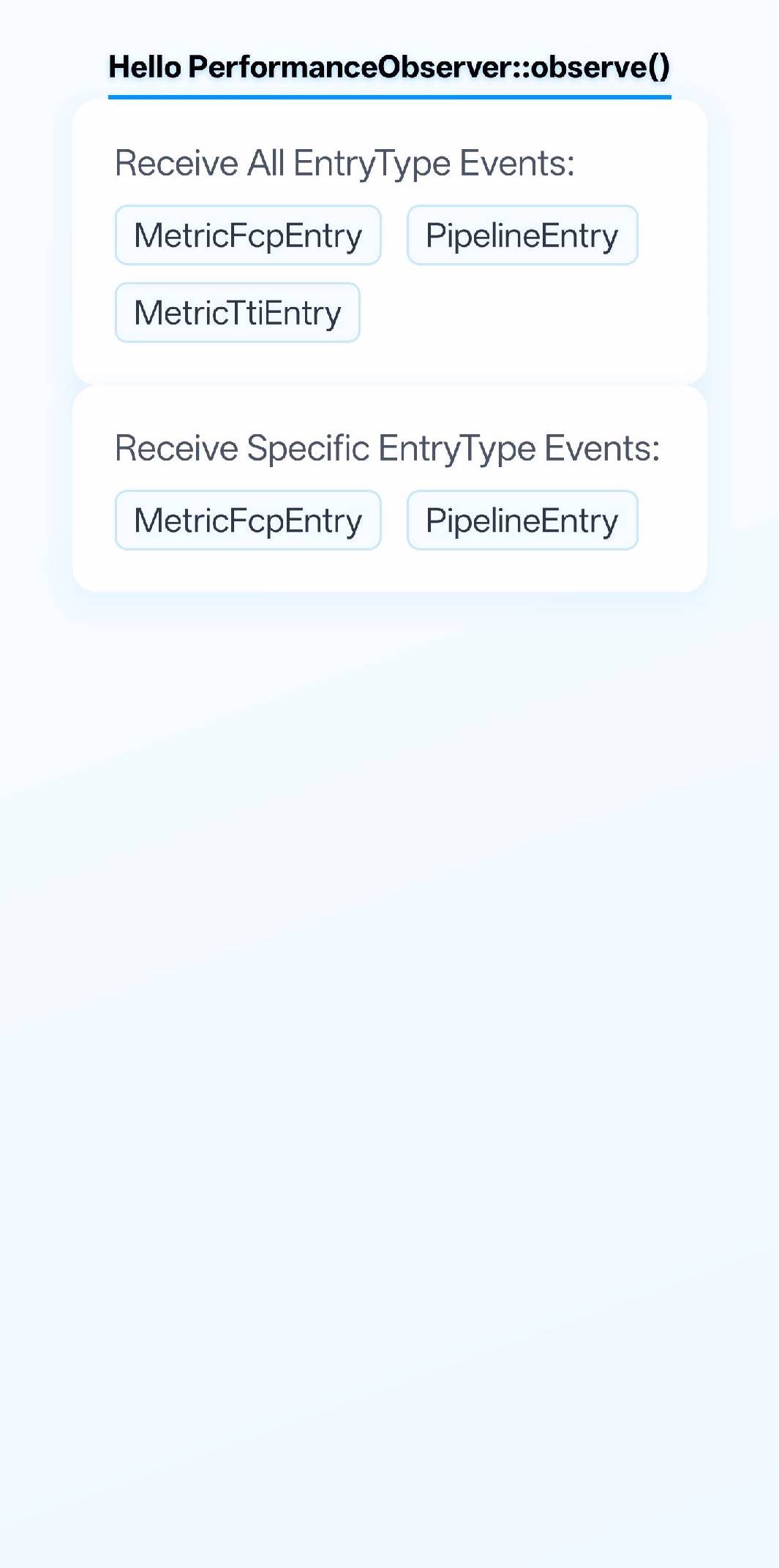
Observing specific performance events
This example creates a PerformanceObserver that observes MetricFcpEntry and the entire PerformanceEntry of type pipeline through ["metric.fcp", "pipeline"].
Compatibility
LCD tables only load in the browser